About Box 1572 Solutions
Our Mission
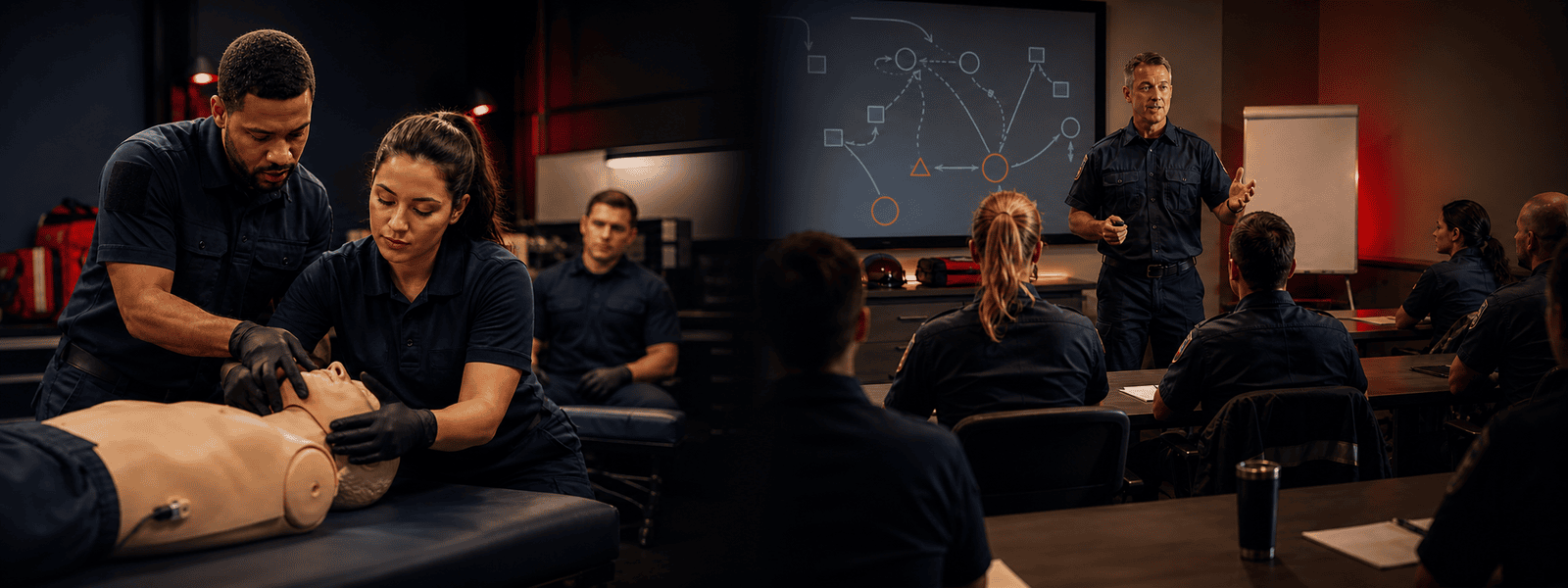
Box 1572 Solutions delivers professional Fire and EMS education, training, and consulting.
You receive instruction built on operational experience, regulatory compliance, and performance standards.
Your students prepare for entry level EMT practice, the Connecticut psychomotor examination process, and the NREMT cognitive exam.
Your agencies gain ready personnel who perform safely, competently, and consistently.
Our Vision
Box 1572 Solutions serves as a trusted provider of Fire and EMS education in Connecticut.
You rely on structured programs, measurable outcomes, and instruction aligned with state and national requirements.
Your communities benefit from a stronger EMS workforce across volunteer and career agencies in New London County.
Program Goals and Community Need
Box 1572 Solutions provides an EMT Initial education program designed to prepare students for entry level EMT practice, the Connecticut psychomotor examination process, and the NREMT cognitive exam. The program supports workforce development across New London County, Connecticut, serving both volunteer and career EMS agencies. This program addresses ongoing staffing needs by developing competent entry level providers who meet state certification requirements and strengthen local emergency medical services capacity.
Leadership
Scott J. Eggert, NREMT, EMS-I
U.S. Navy Senior Chief Hospital Corpsman (Retired). Fire Chief. EMS educator and program builder
Training focuses on competence, accountability, and performance under pressure
Early History
Box 1572 Solutions traces its origins to 2004, when Scott enlisted in the United States Navy as a Hospital Corpsman. After completing initial medical training, he attended Field Medical Service School in 2005 to prepare for assignment with Marine Corps units, where he developed a mindset centered on readiness, resilience, and performance in high risk medical environments.
In April 2006, Scott earned his National Registry EMT certification and served as an EMT with the Camp Hansen Fire Department in Okinawa, Japan. During this assignment, he discovered a passion for training first responders and building operational readiness within emergency services.
His career continued with service in Naval Mobile Construction Battalion 74 in Mississippi, followed by combat deployments to Kuwait and Afghanistan. These experiences reinforced his commitment to medicine, leadership, and training. He later attended the Surface Force Independent Duty Corpsman program, graduating in 2011 and serving as the sole medical provider aboard naval vessels. In this role, he delivered autonomous patient care and trained crews to manage complex medical emergencies, including mass casualty incidents while deployed in the Arabian Gulf.
In 2014, Scott transitioned to instructor duty at the Naval Undersea Medical Institute in Groton, Connecticut, where he supervised the Submarine Independent Duty Corpsman Program and taught trauma care, operational medicine, and medical simulation. He collaborated closely with Hartford Hospital’s Center for Education, Simulation, and Innovation and later earned designation as a Master Training Specialist.
Scott served as the sole medical provider aboard the USS SOUTH DAKOTA (SSN 790) from 2018 to 2022 and completed his naval career at Navy Medicine Readiness & Training Unit Groton, retiring honorably on May 31, 2025 after 20 years of service.
Today, Scott serves as a Senior Business Process Analyst for Optum, leading initiatives focused on healthcare operations, provider enablement, and technology integration. Alongside his civilian career, he remains deeply committed to emergency services as an EMS Instructor and Fire Chief of the Occum Fire Department in Norwich, Connecticut. Through Box 1572 Solutions, he applies decades of operational medical, leadership, and training experience to strengthen Fire and EMS agencies through education, preparedness, and real world skill development.
Why Box 1572?
In keeping with a career rooted in preparing for worst case scenarios, Scott drew inspiration from the response of first responders to the Boston Marathon Bombings on April 15, 2013. As Jay Fleming noted, the outcome reflected extraordinary preparation, coordinated response, and exceptional service. Due to the efforts of the Boston Fire Department, Boston Emergency Medical Services, Boston Police Department, volunteer medical personnel, hospital clinicians, and countless citizens who stepped in to help, every victim who could have survived did survive.
Following the attacks, emergency communications transmitted a call to Strike the Box at 671 Boylston Street, the location of the first explosion. Fire Alarm transmitted Box 1572, prompting an immediate multi agency response to manage the mass casualty incident while maintaining ongoing fire and emergency operations across the city.
This tragedy reinforced several critical lessons for EMS and public safety professionals:
- Always have a plan for every event
- Over preparation is better than under preparation
- Train relentlessly so performance remains automatic under stress
- Knowledge saves lives, expand it continuously
- Commit to lifelong learning as medicine and emergency response evolve
Box 1572 Solutions exists to help agencies prepare for worst case scenarios through planning, training, and operational readiness, so responders are ready when seconds matter most.